
Do you love Washington state history?
Want to help us continue to build HistoryLink?
Check out our new opening for a Development Manager!
8214 HistoryLink.org articles now available.
Diablo Dam incline railway climbing Sourdough Mountain, 1930. Courtesy Seattle Municipal Archives, 2306.
Children waving to ferry, 1950. Courtesy Museum of History and Industry.
Loggers in the Northwest woods. Courtesy Washington State Digital Archives.
Do you love Washington state history?
Want to help us continue to build HistoryLink?
Check out our new opening for a Development Manager!
4/25/2024
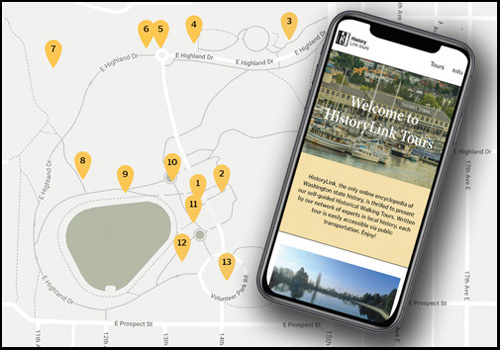
Go Walk Around
May is Historic Preservation Month, and a great way to explore historic locations is with our walking tours at HistoryLink.tours. These highly illustrated tours are self-guided, easily accessible via public transportation, and offer a fascinating glimpse into the history of some of your favorite neighborhoods, parks, and other places around Puget Sound. We're always adding more – one of the most recent ones features the Everett Riverside.
Of course, you can visit them in any order you like, but a good place to start on a warm sunny day is Volunteer Park, an Olmsted-designed landmark park located on Seattle's Capitol Hill. Or visit the Central District, the city's oldest surviving residential area. Make your way down First Hill, head over to the Chinatown-International District, and then stop by the historic Pioneer Square neighborhood to learn about the history of its music scene, its LGBTQ+ community, and its public art. Farther north, you can explore Belltown, then enjoy an architectural tour of Pike Place Market, which is also the home of our HistoryLink office. Wander the central waterfront, then walk from the market to MOHAI.
Don't miss our other walking tours of Tacoma’s Union Station/Warehouse Historic District, Everett's Forest Park, downtown Snohomish, Issaquah, South Lake Union, and Pike Place Market eateries. Now go out there to enjoy, and probably learn something new!
What's That Sound?
On April 28, 1940, experimental-music pioneer John Cage debuted his "prepared piano" at Seattle's Repertory Playhouse. The instrument was augmented with screws, bolts, nuts, and leather strips that dampened the strings and produced a cacophony of sounds. This week also marks the anniversary of another avant-garde musical performance, when on May 1, 2015, the Seattle Symphony debuted Seattle sound sculptor Trimpin's site-specific composition "Above, Below, and in Between" at Benaroya Hall.
But probably the strangest musical experiment performed this week in Washington's past took place in Duvall on April 28, 1968, when thousands were on hand to watch a piano drop from a helicopter and hear what it sounded like when it hit the ground (answer: a disappointing fooomp!) Anti-climactic as that was, the crowd of hippies, fringies, and freaks partied on into the night to the music of Country Joe and the Fish and local bands.
By the time it was over, at least one person was heard to say, "Hey, let’s do that again!" And so, from an unsound beginning sprang the idea for that summer's Sky River Rock Festival, one of the first outdoor, multi-day musical events of its kind. The following year Sky River II was held near Tenino, just two weeks after the Woodstock festival in New York. In 1970, a third Sky River Festival (run by different promoters) ended up being a money-loser, as would the troubled Satsop River Fair and Tin Cup Races, held in 1971.
April 29 marks the birthday of three Washington communities. Issaquah incorporated as Gilman on April 29, 1892, Toppenish incorporated on April 29, 1907, and Brewster incorporated on April 29, 1910.
On April 30, 1910, electric interurban trains began to shuttle between Everett and Seattle. Now that the cities were more accessible, some commuters bought homes in communities like Shoreline, Edmonds, and Lynnwood. By the time Highway 99 was completed in 1932, automobiles had become the preferred form of travel, and the railway was abandoned in 1939.
On April 25, 1912, the steamship Alameda rammed Seattle's Colman Dock and toppled its clock tower into Elliott Bay. The accident led to an even greater tragedy three weeks later when a gangplank failed during the dock's reconstruction, injuring 58 and drowning two.
On April 28, 1919, Seattle mayor Ole Hanson received a bomb in the mail, as part of a nationwide plot by anarchists to attack politicians and well-known businessmen. Fortunately, it did not explode. The same can't be said for an aerial bomb that fatally injured Spokane pioneer aviator Major John T. Fancher on April 29, 1928, during a flight demonstration. Fancher had been instrumental in bringing the 1927 National Air Derby and Air Races to Felts Field.
On May 1, 1937, Dr. Alan L. Hart's third novel, In the Lives of Men, was published. Hart, who grew up as a girl in Oregon and lived his adult life as a man, set his story about a physician in the fictional town of Fairharbor – a clear stand-in for Tacoma, where Hart had served from 1930-1932 as head of radiology at Tacoma General Hospital.
On April 26, 1987, the Washington Wine Commission was approved by the Washington State Legislature. Four months later, 12 people were named the commission's first members: five growers, one liquor wholesaler, and six winery operators led by Allen Shoup of Chateau Ste. Michelle, Dave Adair of Columbia Winery, and Mike Hogue of Hogue Cellars.
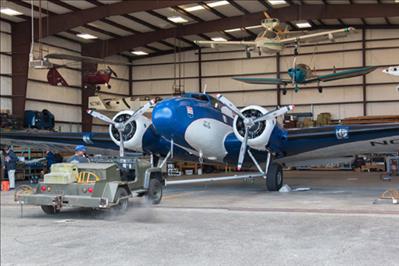
On April 26, 2016, the restored Boeing 247D airliner NC13347 made its final flight, from Paine Field to Boeing Field.
"Everywhere is walking distance if you have the time."
–Steven Wright











HistoryLunch is coming on September 12.
×